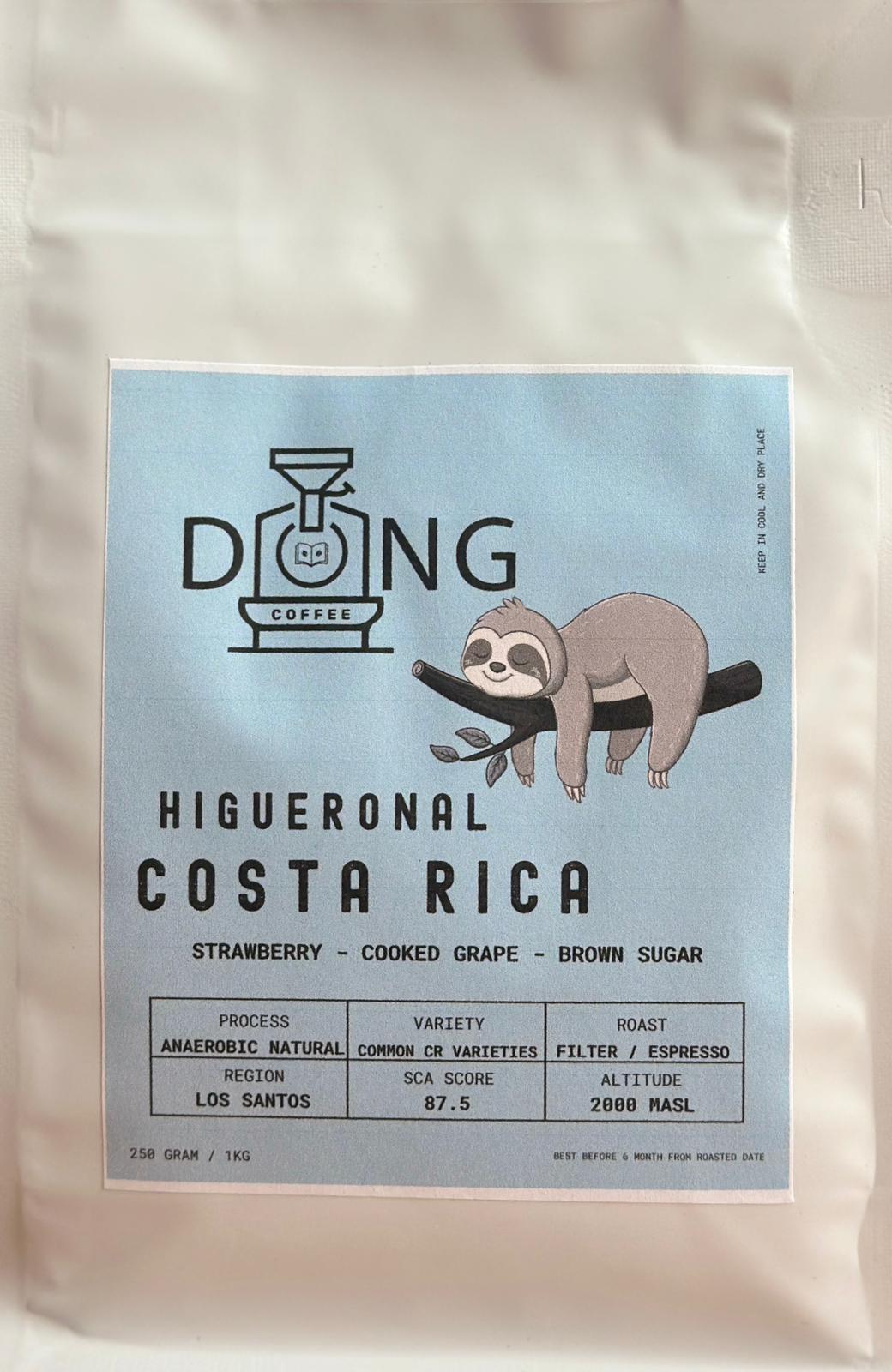
Costa Rica, Higueronal
Van Solís Micromill is a family-run business led by Ivan Solís Rivera and the Solís Cordero family. It was founded in 2018 to sustainably produce, process, and market specialty coffees while highlighting the classic characteristics of Santa María de Dota coffees.The farms that contribute to the micromill are located at high elevations with productive soil for growing coffee and avocado. The Los Santos area is known for producing some of the best coffee in the country. In addition, a large part of the area is used as a conservation area, which gives the region a national tourist attraction.Ivan Solís Micromill is dedicated to selecting the best fruit Process and processes to produce coffees with unique and differentiated profiles. They use Washed, Semi-washed, Honey, Natural, and Natural Anaerobic processes. The company has an exclusive roasting area for the national markets, to provide high quality coffees at a local level. The Sagaz Coffee brand represents the quality of the
coffee produced in Santa Maria de Dota, conserving sweet, citric, and fruity flavors
in its different profiles.One of the areas to highlight within the organization is
sustainable development. Sagaz Coffee currently holds the Costa Rican Essential
License, NAMA coffee certification, and participates in environmental programs
such as Green Growth and Low Emission Incentives in institutions such as
Procomer and ICAFE.
Costa Rica Ivan Solis Micromill – Finca Higueronal – F1 – Anaerobic – Natural
As the first Central American country to fully establish a coffee industry, the history of coffee in Costa Rica is long and full of great economic significance. Coffee was planted in Costa Rica in the late 1700s but it was not until the 1820s that coffee became a major agricultural export for the country. In 1846, national output was greatly increased by the completion of a main road to Puntarenas, allowing farmers to more readily bring their coffee from their farms to market in oxcarts—which remained the way most small farmers transported their coffee until the 1920s.In 1933, the national coffee association, Icafe (Instituto del Café de Costa Rica), was established as an NGO designed to assist with the agricultural and commercial development of the Costa Rican coffee market. It is funded by a 1.5% export tax on all Costa Rican coffee, which contributes to the organization’s $7 million budget, used for scientific research into Arabica genetics and biology, plant pathology, soil and water analysis, and oversight of the national coffee industry. Among other things, Icafe exists to guarantee that contract terms for Costa Rican coffee ensure the farmer receives 80% of the FOB price (“free on board,” the point at which the ownership and price risks are transferred from the farmer/seller to the buyer).Though Costa Rica contributes less than 1% of the world’s coffee production, it has a strong reputation for producing relatively good, if often mild quality. One way that Costa Rica has hoped to differentiate itself among coffee-growing nations is through the diversity of profiles in its growing regions, despite the country’s relatively small geographical size. Tarrazú might be the most famous of the regions: Its high altitudes contribute to its coffees’ crisp acidity. West Valley—known for its high percentage of Cup of Excellence winners—grows an abundance of both the Costa Rica–specific varieties Villa Sarchi and Villa Lobos, as well as some of the more “experimental” varieties that have come here, such as SL-28 and Gesha. Tres Ríos coffee has a reputation for a smooth, milder profile—perhaps more “easy drinking” with toffee sweetness and soft citrus than the more complex or dynamic Costas available. Central Valley has some of the most distinct weather patterns in the country, with well-defined wet and dry seasons: We have found some of the best natural processed coffees in this region.In recent years, coffee producers have become increasingly interested in using variety selection as another way to stand out in the competitive market: SL-28 and Gesha are becoming more common, and local varieties like Villa Sarchi (a dwarf Bourbon mutation found near the town of Sarchi) and Venesia (a Caturra mutation).
Santa María de Dota is a canton in the San Jose province of Costa Rica. This area is cool and mountainous. Its high elevation
and shade make it a popular location for growing coffee. This region is a part of the Los Santos zone, a group of towns named
after saints throughout Santa María de Dota, Tarrazú, and León Cortés Castro.
| size | 1kg, 250grams |
|---|
Related products

Colombia Betulia
22,90 € – 81 €Colombia Manos Juntas
19,40 € – 67,50 €Indonessia Asman Gayo
19,40 € – 67,50 €AFONSO BRAZIL
14,60 € – 48,40 €Ethiopia Dembi
15,90 € – 53 €