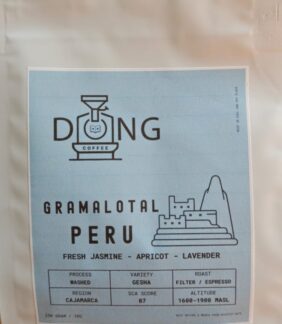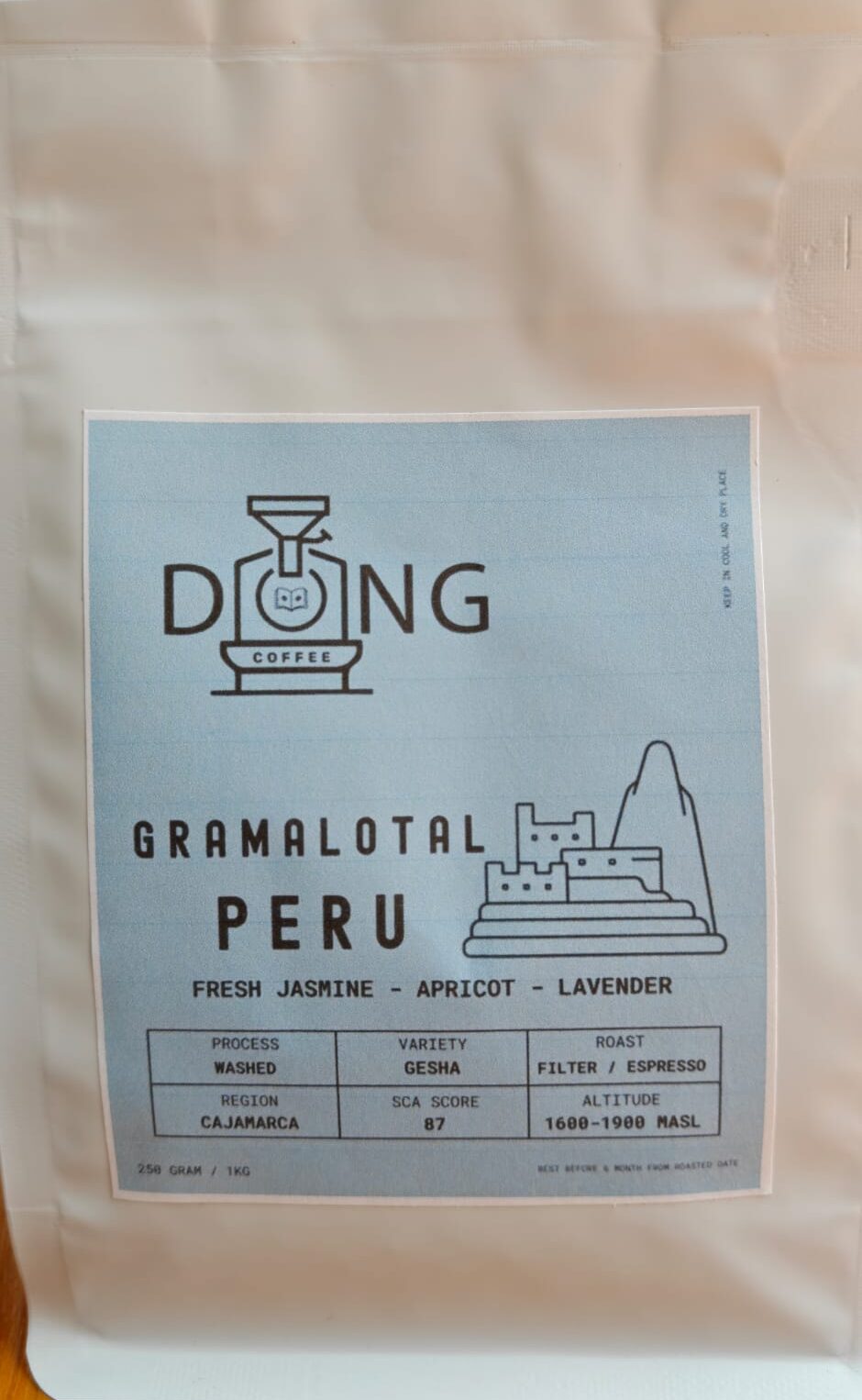
Peru Gramalotal
Country: Peru Yoryi Yimer Berru – Finca Gramalotal – La Coipa – Gesha
Though coffee arrived in Peru relatively early—in the middle of the 1700s—it wasn’t cultivated for commercial export until
nearly the 20th century as demand from Europe rose due to a significant decrease in coffee production in Indonesia. British
presence and influence in the country helped increase and drive exports. In the early 1900s, the British government took
ownership of roughly 2 million hectares of land from the Peruvian government as payment on a defaulted loan, and much of
that land became British-owned coffee plantations.As in many Central and South American countries, the large European
owned landholdings were sold or redistributed throughout the 20th century. Farms became smaller and more fragmented,
offering independence to farmers but also limiting their access to resources and a larger commercial market. Unlike many
other countries whose coffee economy is dominated by smallholders, Peru lacks the organization or infrastructure to provide
economic or technical support to farmers—a hole that outside organizations and certifications have sought to fill. The country
has a remarkable number of certified-organic coffees, as well as Fair Trade, Rainforest Alliance, and UTZ-certified coffees.
Around 30 percent of the country’s smallholders are members of democratic co-ops, which has increased the visibility of
coffees from the area but has done little to bring incredibly high-quality lots into the spotlight.As of the 2010s, Peru is one of
the top producers of Arabica coffee, often ranked fifth in world production and export of Arabica. The remoteness of the coffee
farms and the incredibly small size of the average farm have prevented much of the single-farm differentiation that has
allowed for microlot development and marketing in other growing regions, but as with everything else in specialty coffee, this
is changing quickly as well. The country’s lush highlands and good heirloom varieties offer the potential for growers to beat the
obstacles of limited infrastructure and market access, and as production increases, we are more likely to see those types of
advancements.
The Cup: Fresh jasmine, artificial raspberry, and fresh lavender with mild fresh apricot flavors.
Clean fruit-like sweetness and winey acidity.
Country: Peru Yoryi Yimer Berru – Finca Gramalotal – La Coipa – Gesha
Though coffee arrived in Peru relatively early—in the middle of the 1700s—it wasn’t cultivated for commercial export until
nearly the 20th century as demand from Europe rose due to a significant decrease in coffee production in Indonesia. British
presence and influence in the country helped increase and drive exports. In the early 1900s, the British government took
ownership of roughly 2 million hectares of land from the Peruvian government as payment on a defaulted loan, and much of
that land became British-owned coffee plantations.As in many Central and South American countries, the large European
owned landholdings were sold or redistributed throughout the 20th century. Farms became smaller and more fragmented,
offering independence to farmers but also limiting their access to resources and a larger commercial market. Unlike many
other countries whose coffee economy is dominated by smallholders, Peru lacks the organization or infrastructure to provide
economic or technical support to farmers—a hole that outside organizations and certifications have sought to fill. The country
has a remarkable number of certified-organic coffees, as well as Fair Trade, Rainforest Alliance, and UTZ-certified coffees.
Around 30 percent of the country’s smallholders are members of democratic co-ops, which has increased the visibility of
coffees from the area but has done little to bring incredibly high-quality lots into the spotlight.As of the 2010s, Peru is one of
the top producers of Arabica coffee, often ranked fifth in world production and export of Arabica. The remoteness of the coffee
farms and the incredibly small size of the average farm have prevented much of the single-farm differentiation that has
allowed for microlot development and marketing in other growing regions, but as with everything else in specialty coffee, this
is changing quickly as well. The country’s lush highlands and good heirloom varieties offer the potential for growers to beat the
obstacles of limited infrastructure and market access, and as production increases, we are more likely to see those types of
advancements.
The Cup: Fresh jasmine, artificial raspberry, and fresh lavender with mild fresh apricot flavors.
Clean fruit-like sweetness and winey acidity.
Program: Microlot
Microlots from Peru are traceable to the farm level, and represent both the highest
quality and the highest prices paid to the producer. At times, these can be
individual members of certified coops
Variety: Gesha Yoryi Yimer Berru – Finca Gramalotal – La Coipa – Gesha
There are two primary genetic strains of Gesha (1931; 1956) but both are derivative from Ethiopian landrace varieties collected
by the British in the 1930s.
Process: Washed Yoryi Yimer Berru – Finca Gramalotal – La Coipa – Gesha
The vast majority of coffee in Perú is Washed, and many producers own their own wet-milling equipment, though smallholders
may also deliver cherry to a central processing unit or cooperative for processing. The coffees are usually depulped the same
day they are harvested and given a 12–18-hour open-air fermentation before being washed clean of mucilage. (The
fermentation time may be longer in cooler areas at higher elevations.) Drying styles vary in Perú, and coffee may be dried on
patios, raised beds, in parabolic dryers, or mechanically
| size | 1kg, 250grams |
|---|
Related products

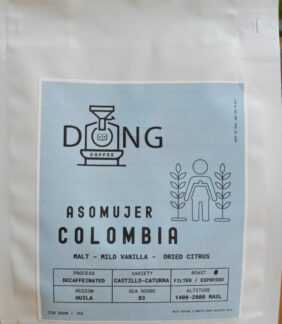
Colombia- Decaffeinated
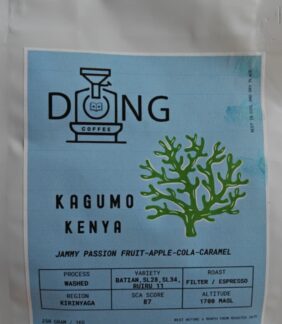
17,80 € – 62,80 €Kenya- Kagumo
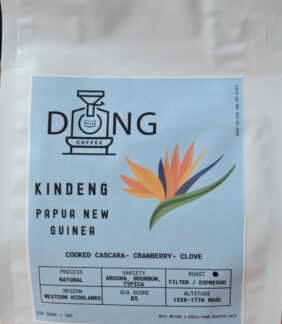
18,80 € – 64 €Papua New Guinea, Kindeng
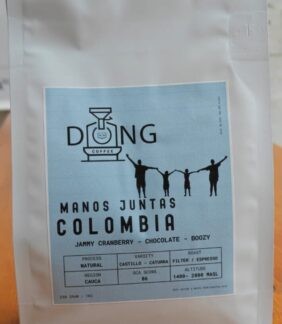
16,70 € – 55,50 €Colombia Manos Juntas
19,40 € – 67,50 €Colombia Betulia
22,90 € – 81 €